This website uses cookies
We use cookies to personalise content and ads, to provide social media features and to analyse our traffic. We also share information about your use of our site with our social media, advertising and analytics partners who may combine it with other information that you’ve provided to them or that they’ve collected from your use of their services.
Consent Selection
Details
  • Necessary cookies help make a website usable by enabling basic functions like page navigation and access to secure areas of the website. The website cannot function properly without these cookies.
    • Learn more about this provideropens in a new window
      CookieConsentStores the user's cookie consent state for the current domain
      Maximum Storage Duration: 1 yearType: HTTP Cookie
    • Learn more about this provideropens in a new window

      Some of the data collected by this provider is for the purposes of personalization and measuring advertising effectiveness. The provider may use the IP Addresses for ads measurement and ads personalization.

      test_cookieUsed to check if the user's browser supports cookies.
      Maximum Storage Duration: 1 dayType: HTTP Cookie
    • Learn more about this provideropens in a new window
      __cf_bmThis cookie is used to distinguish between humans and bots. This is beneficial for the website, in order to make valid reports on the use of their website.
      Maximum Storage Duration: 1 dayType: HTTP Cookie
      cf_clearanceThis cookie is used to distinguish between humans and bots.
      Maximum Storage Duration: 1 yearType: HTTP Cookie
  • Preference cookies enable a website to remember information that changes the way the website behaves or looks, like your preferred language or the region that you are in.
    • We do not use cookies of this type.

  • Statistic cookies help website owners to understand how visitors interact with websites by collecting and reporting information anonymously.
    • Learn more about this provideropens in a new window
      p.gifKeeps track of special fonts used on the website for internal analysis. The cookie does not register any visitor data.
      Maximum Storage Duration: SessionType: Pixel Tracker
    • Learn more about this provideropens in a new window

      Some of the data collected by this provider is for the purposes of personalization and measuring advertising effectiveness. The provider may use the IP Addresses for ads measurement and ads personalization.

      _gaUsed to send data to Google Analytics about the visitor's device and behavior. Tracks the visitor across devices and marketing channels.
      Maximum Storage Duration: 2 yearsType: HTTP Cookie
      _ga_#Used to send data to Google Analytics about the visitor's device and behavior. Tracks the visitor across devices and marketing channels.
      Maximum Storage Duration: 2 yearsType: HTTP Cookie
  • Marketing cookies are used to track visitors across websites. The intention is to display ads that are relevant and engaging for the individual user and thereby more valuable for publishers and third party advertisers.
    • Learn more about this provideropens in a new window

      Some of the data collected by this provider is for the purposes of personalization and measuring advertising effectiveness. The provider may use the IP Addresses for ads measurement and ads personalization.

      pagead/1p-user-list/#Tracks if the user has shown interest in specific products or events across multiple websites and detects how the user navigates between sites. This is used for measurement of advertisement efforts and facilitates payment of referral-fees between websites.
      Maximum Storage Duration: SessionType: Pixel Tracker
      _gcl_auUsed to measure the efficiency of the website’s advertisement efforts, by collecting data on the conversion rate of the website’s ads across multiple websites.
      Maximum Storage Duration: 3 monthsType: HTTP Cookie
      _gcl_lsTracks the conversion rate between the user and the advertisement banners on the website - This serves to optimise the relevance of the advertisements on the website.
      Maximum Storage Duration: PersistentType: HTML Local Storage
    • Learn more about this provideropens in a new window
      __cf_obPending
      Maximum Storage Duration: SessionType: HTTP Cookie
      _cfPre_tabIdPending
      Maximum Storage Duration: SessionType: HTML Local Storage
    • Learn more about this provideropens in a new window
      __Secure-BUCKETPending
      Maximum Storage Duration: 180 daysType: HTTP Cookie
      __Secure-ROLLOUT_TOKENUsed to track user’s interaction with embedded content.
      Maximum Storage Duration: 180 daysType: HTTP Cookie
      __Secure-YECStores the user's video player preferences using embedded YouTube video
      Maximum Storage Duration: SessionType: HTTP Cookie
      __Secure-YNIDUsed to track user’s interaction with embedded content.
      Maximum Storage Duration: 180 daysType: HTTP Cookie
      LAST_RESULT_ENTRY_KEYUsed to track user’s interaction with embedded content.
      Maximum Storage Duration: SessionType: HTTP Cookie
      LogsDatabaseV2:V#||LogsRequestsStoreUsed to track user’s interaction with embedded content.
      Maximum Storage Duration: PersistentType: IndexedDB
      TESTCOOKIESENABLEDUsed to track user’s interaction with embedded content.
      Maximum Storage Duration: 1 dayType: HTTP Cookie
      VISITOR_INFO1_LIVETries to estimate the users' bandwidth on pages with integrated YouTube videos.
      Maximum Storage Duration: 180 daysType: HTTP Cookie
      YSCRegisters a unique ID to keep statistics of what videos from YouTube the user has seen.
      Maximum Storage Duration: SessionType: HTTP Cookie
      yt-icons-last-purgedNecessary for the implementation and functionality of YouTube video-content on the website.
      Maximum Storage Duration: PersistentType: HTML Local Storage
      ytidb::LAST_RESULT_ENTRY_KEYUsed to track user’s interaction with embedded content.
      Maximum Storage Duration: PersistentType: HTML Local Storage
      YtIdbMeta#databasesUsed to track user’s interaction with embedded content.
      Maximum Storage Duration: PersistentType: IndexedDB
  • Unclassified cookies are cookies that we are in the process of classifying, together with the providers of individual cookies.
    • matrix_last_commercial_productPending
      Maximum Storage Duration: SessionType: HTML Local Storage
Cookie declaration last updated on 10/12/26 by Cookiebot
[#IABV2_TITLE#]
[#IABV2_BODY_INTRO#]
[#IABV2_BODY_LEGITIMATE_INTEREST_INTRO#]
[#IABV2_BODY_PREFERENCE_INTRO#]
[#IABV2_BODY_PURPOSES_INTRO#]
[#IABV2_BODY_PURPOSES#]
[#IABV2_BODY_FEATURES_INTRO#]
[#IABV2_BODY_FEATURES#]
[#IABV2_BODY_PARTNERS_INTRO#]
[#IABV2_BODY_PARTNERS#]
About
Cookies are small text files that can be used by websites to make a user's experience more efficient.

The law states that we can store cookies on your device if they are strictly necessary for the operation of this site. For all other types of cookies we need your permission.

This site uses different types of cookies. Some cookies are placed by third party services that appear on our pages.

You can at any time change or withdraw your consent from the Cookie Declaration on our website.

Learn more about who we are, how you can contact us and how we process personal data in our Privacy Policy.

Please state your consent ID and date when you contact us regarding your consent.

Reframing Glute Training as a Longevity Strategy

March 9, 2026

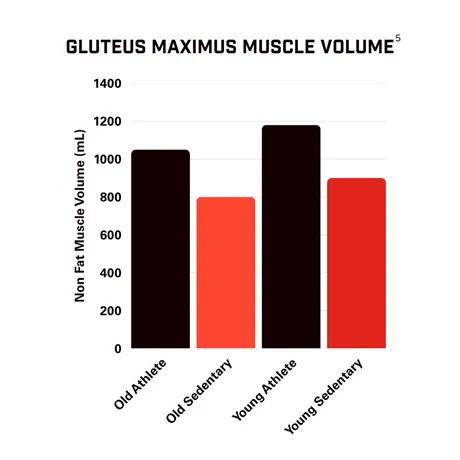
The glutes are one of the most important muscles for mobility and metabolic health. Gluteus maximus is the largest portion of the “glutes” and contributes to about 4% of total body muscle volume in active individuals.1 These muscles extend the hip, a motion crucial to walking, climbing stairs and rising from a chair. They are also highly insulin sensitive, making them a major site for glucose uptake and storage.2 While often trained for appearance, their real importance lies in how they power everyday movements and support metabolic health.
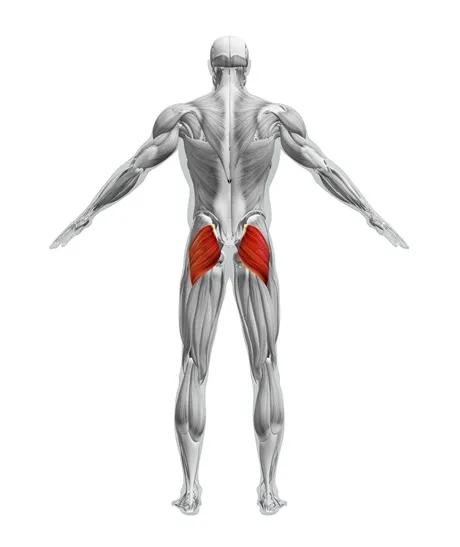
As glutes weaken, hip extension power drops, causing more load to the spine and knees in ways that increase the risk of pain and injury. The loss of glute strength signals a loss of functional capacity, making daily tasks feel harder. Metabolically, the loss of lower body mass reduces glucose disposal, worsening insulin sensitivity. These consequences have prompted researchers to treat glute size and shape as objective markers of metabolic health.

Research on Glute Shape

A large-scale imaging study examined how the three-dimensional shape of the gluteus maximus varies with age, activity, sedentary time, and type 2 diabetes. Rather than focusing only on muscle size, the researchers analyzed surface shape patterns across thousands of participants.

A clear trend emerged. Greater strength and physical activity were associated with outward expansion of the muscle surface, consistent with more contractile tissue, whereas aging, frailty, and prolonged sitting were linked to inward surface changes that suggest tissue loss.3

Interestingly, type 2 diabetes appeared differently in men and women.3 In men, diabetes was associated with gluteal flattening and inward changes that reflect atrophy and low muscle quality. In women, diabetes was associated with outward changes that appear to reflect fat accumulating within the muscle. The practical takeaway for fitness professionals is that loss of glute strength and size is associated with worse metabolic health, and for women, larger is not always better.

Facilities Need Practical Proxies

Most fitness facilities do not have access to advanced imaging, and they do not need it. What they need are repeatable, practical ways to track whether lower-body muscle tissue is being preserved or built over time. Facilities can encourage repeated strength assessments on equipment or movements that involve the glutes, and they may also consider non-invasive body composition assessments.

Bioelectrical impedance analysis (BIA) estimates how much of the body is made up of fat mass and fat-free mass by passing a small electrical current through the body. More advanced systems can also estimate lower-extremity lean mass, which serves as a reasonable proxy for changes driven by resistance training. BIA does not measure the glute muscle directly, but trends in lower body lean mass provide meaningful insight into whether training is supporting muscle growth or protecting muscle during weight loss.
Using BIA in a Muscle-Centered Way

When BIA is used only to track fat loss, its value is reduced to a single outcome. Its greater utility may be showing whether lean tissue is being preserved, gained, or lost. This distinction matters because weight loss usually includes a loss of muscle, and the extent to which this occurs reflects whether your members are resistance training and taking in enough protein.4

With repeated BIA measures, facilities can help to shift the conversation away from a member’s scale weight and toward tissue preservation and growth. This means that instead of asking about body weight, professionals can ask whether their members kept or built muscle, especially in the lower body. That framing aligns naturally with glute-focused training as a health and longevity strategy, not just appearance.

What This Means for Fitness Professionals

Glute training should be positioned as an investment in mobility, metabolic health, and resilience with age. Pairing repeated strength testing with body composition tools provides the ideal context, revealing whether the lower body is producing more force and whether it is increasing or being preserved over time. When combined with progressive resistance training, this approach helps members realize measurable gains in muscle and performance rather than appearance alone.