

Muscle Strengthens Blood Sugar Control



Fitness professionals already know that muscle matters for strength and physical function. Less appreciated is how muscle gives members real protection against high blood sugar. Helping members understand this relationship reinforces the value of strength training and can build confidence in the programs you design.
Muscle is the Primary Sugar Sink
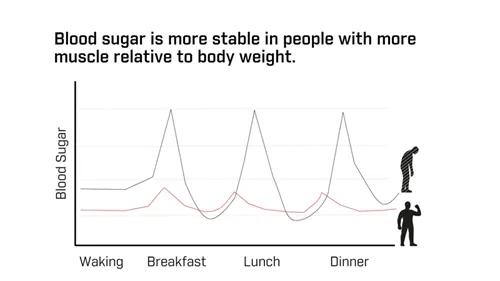
When members eat sweets or carbohydrate-rich meals, they likely know their blood sugar will rise, but few realize that their muscles are the main tissue responsible for clearing it. After eating, skeletal muscle pulls in more than 80% of post-meal blood sugars.1 Building muscle helps to buffer against high blood sugar, keeping energy steadier throughout the day.
Muscle Health Drives Metabolic Health
Skeletal muscle health matters because it’s closely linked to how the body responds to insulin, the main hormone that prevents high blood sugar.
Insulin resistance develops if the body becomes less responsive to this hormone. Skeletal muscle is often the first tissue to show this resistance, even before the liver or fat tissue.2 As a result, sugar stays in the bloodstream longer, contributing to blood sugar spikes and post-meal fatigue. This can develop into type 2 diabetes over time.
Individuals with low muscle mass face more than twice the risk of developing type 2 diabetes compared to those with higher relative muscle mass.3 This risk remains even after adjusting for body fat percentage, confirming that low muscle mass is an independent risk factor for type 2 diabetes.4
The Fastest Way to Improve Insulin Sensitivity
While muscle may be the first tissue to lose insulin responsiveness, it’s also among the quickest to regain it. In fact, a single workout can reinstate insulin sensitivity for about 24 to 48 hours.5 Regular training is even more effective, helping to build muscle and improve muscle quality, enhancing sugar regulation over time. This benefit holds true even for individuals with type 2 diabetes who only strength train.6
Exercise rapidly improves blood sugar control, and it does so without relying on insulin. Muscle contractions activate signals in the cell that move sugar transporters to the cell surface, allowing sugar to enter the muscle cells even in the absence of insulin.7 Over time, regular strength training enhances this signal, increasing both the number and responsiveness of these transporters on the muscle cell surface.8
Programming Tips for Trainers:
- Make muscle development a priority in your programming, helping members shift their focus from a number on the scale to the capacity of their body.
- Emphasize large muscle groups such as the legs and back to increase total sugar uptake capacity.9
- Use progressive overload principles at moderate to high intensity to promote muscle growth.
- Schedule strength training at least 2-3 times per week to maintain metabolic benefits.
- Encourage light walking or mobility exercises after meals to help members clear sugars from the bloodstream.10
Language Choices That Stick
When helping members understand the metabolic value of muscle, simple metaphors often land better than clinical terms. For example, muscles are like a sponge that soaks up sugar after you eat, and muscles help us avoid energy dips after big meals. Emphasizing stable energy and feeling better may be more memorable than risk reductions in diabetes or insulin resistance.
Frame the Message Around Gains
In your discussions with members, keep it positive. Gain-framed messages remind them what they are working toward, while loss-framed messages highlight what’s at stake if they don’t workout. Messages that focus on what members can gain provide better exercise motivation and consistency.11
This helps explain why messages about avoiding future disease often fall flat, while goals like developing muscle, improving strength, and achieving more daily energy are more motivating. Framing progress around gains positions muscle as a long-term health objective, helping members stay inspired to build a stronger, healthier body.

Karlie Intlekofer, PhD, CNC, CPT
References
- Abel. Regulation of postabsorptive and glucose metabolism by skeletal muscle. Nutrients. 2021;13(1): 159.
- DeFronzo & Tripathy. Skeletal muscle insulin resistance is the primary defect in type 2 diabetes. Diabetes Care 2009; 32(Suppl 2): 157-63.
- Hong et al. Relative muscle mass and risk of incident type 2 diabetes: A cohort study. PLOS One 2017; 12(11): e01887650.
- Son et al. Low muscle mass and risk of type 2 diabetes in middle-aged and older adults: findings from the KoGES. Diabetologia 2017; 60: 865-72.
- Heath et al. Effects of exercise and lack of exercise on glucose tolerance and insulin sensitivity. J Appl Physiol 1983; 55(2): 512-7.
- Holten et al. Strength training increases insulin-mediated glucose uptake, GLUT4 content, and insulin signaling in skeletal muscle in patients with type 2 diabetes. Diabetes 2004; 53(2): 294-305.
- Richter & Hargreaves. Exercise, GLUT4, and skeletal muscle glucose uptake. Physiol Rev 2013; 93(3): 993-1017.
- Richter et al. Signalling to glucose transport in skeletal muscle during exercise. Acta Physiol Scand 2003; 178(4): 329-35.
- Hawley & Lessard. Exercise training-induced improvements in insulin action. Acta Physiol 2008; 192(1): 127-35.
- DiPietro et al. Three 15-min bouts of moderate post-meal walking significantly improves 24-h glycemic control in older people at risk for impaired glucose tolerance. Diabetes Care 2013; 36(10): 3262-8.
- Latimer et al. Promoting exercise behavior: An integration of message framing and self-determination theory. Health Educ Res 2008; 23(5): 776-88.

